Build-up Manhunt: when tagged players join the hunters
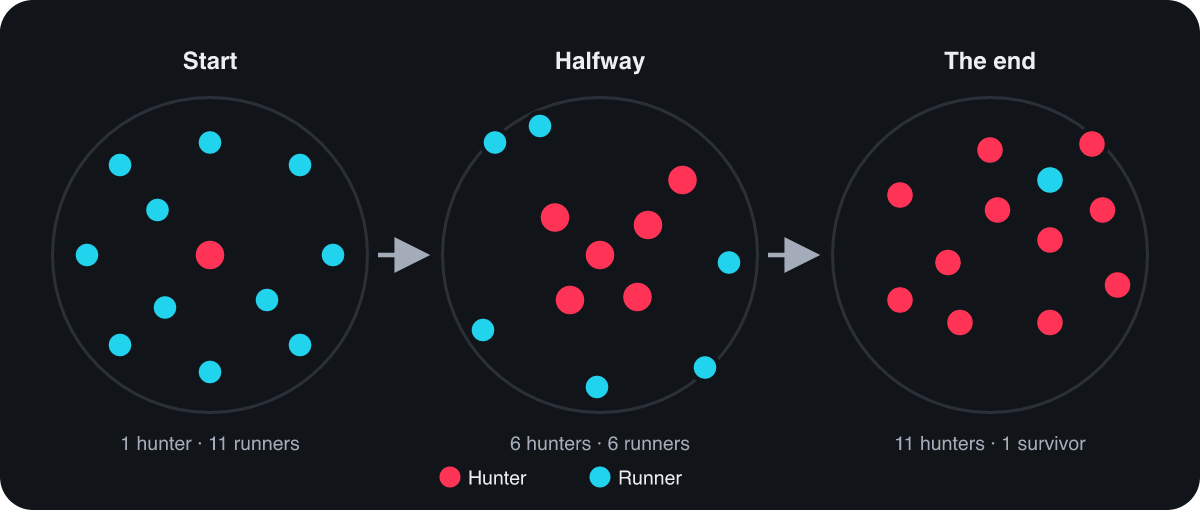
Build-up Manhunt (also called infection, zombie tag or reverse Manhunt) starts with one or two hunters, and every runner they tag becomes a hunter too. The pack grows until a single survivor is left or time runs out. There's no jail, so nobody sits out, which makes it the best version of Manhunt for big groups.
Key facts
- Start with: 1 hunter for up to 10 players, 2 for 11 to 20, 3 for 21 to 30.
- Tagged? You switch sides on the spot and start hunting.
- No jail and no rescues. The only way back is the next round.
- Winner: the last runner left, or every runner still free when the 10 to 20 minute timer ends.
- Next round: the first runner tagged starts as the hunter.
How to play build-up Manhunt
- Choose the first huntersOne hunter for up to 10 players, two for 11 to 20, three for 21 to 30. Volunteers, or whoever lost the last round.
- Set the boundary and the timeThe same boundary as classic Manhunt, and a 10 to 20 minute timer. Smaller areas make the endgame come faster.
- Head startHunters close their eyes at the start point and count while runners hide, for 1 to 3 minutes.
- Tag and switchA light touch on the shoulder or back. The tagged runner says "got me", counts to five out loud, and joins the hunters.
- Last survivorWhen one runner is left, call it out so everyone knows. They win if they survive to the whistle.
“Manhunt” means two different games depending on where you grew up. In one, caught runners go to jail and wait to be rescued: that’s Jailbreak, the version on our rules page. In the other, caught runners join the hunt. That second game is build-up Manhunt, and it’s the one to reach for when the group is big, the night is short, or half the players are too young to enjoy sitting in jail.
Why it works so well
- Nobody sits out. Being tagged isn’t the end of your game; it’s a change of team.
- The pressure builds by itself. With one hunter, runners are bold. With eight, every shadow could be a hunter.
- It always ends. A growing pack finds everyone eventually, so there’s no stalemate and no need for a rule against hiding all game.
- The finale is dramatic. One survivor against a crowd is the moment people film.
Three versions
Zombie infection. The theatrical version: hunters are zombies who walk (never run) with arms out and moan, and tagged runners “turn” with a dramatic count to five. Perfect for Halloween and younger groups, and the second round of our Halloween Manhunt night.
Reverse Manhunt. Start the other way round: one or two runners hide and everyone else hunts. Runners win by surviving the timer. It’s quick, great for small yards, and close to how some towns play plain “Manhunt”.
Build-up with the 1-2-3 hold. In some neighborhoods a tag only counts if the hunter holds the runner with both hands and chants “Manhunt, manhunt, 1-2-3!” before the runner twists free. It makes every catch a struggle, so set limits first: hold arms or shoulders only, no tackling, no pulling clothes, and let go the moment the chant ends.
Making the ending fair
When there are 20 hunters and one runner, the end can come too fast. Groups use small tweaks:
- Call the count. When three runners are left, someone shouts it, so survivors know to be careful and hunters know to spread out.
- A breather for the last two. Hunters freeze and count to ten out loud once, when only two runners remain.
- Shrink the time, not the area. A 12-minute round keeps the finale tense without making it hopeless.
Build-up or Jailbreak?
| Difference | Build-up Manhunt | Jailbreak Manhunt |
|---|---|---|
| Best group size | 10 to 30+ | 6 to 20 |
| When you’re caught | You hunt | You wait in jail |
| Comebacks | None: it only goes one way | Constant: any runner can free everyone |
| Length | 10 to 20 minutes | 15 to 30 minutes |
| Best for | Big groups, young players, short nights | Teens and adults, tactical groups |
Many groups alternate: a build-up round to warm up and learn the area, then Jailbreak once everyone knows the hiding spots.
Build-up Manhunt questions
What is Manhunt 1-2-3?
It's a tagging house rule used in some neighborhoods: instead of a quick touch, the hunter holds the runner and chants "Manhunt, manhunt, 1-2-3!". If the runner breaks free before the chant ends, the tag doesn't count. It echoes the old New York street game ringolevio, where a captor held a player through "Ringolevio, 1-2-3". Hold arms or shoulders, never tackle, and let go the moment the chant ends.
Is build-up Manhunt the same as zombie tag?
Yes, it's the same game with different flavor. Zombie tag adds theater: hunters are zombies who walk with arms out and groan, and tagged runners "turn". The rules underneath are identical.
Why is it called reverse Manhunt?
Because by the end, almost everyone is hunting and one or two people are hiding, the reverse of how the round started. Some groups start it that way too, with only one or two runners.
Is build-up Manhunt good for big groups?
It's the best version for them. Nobody waits in jail, every tag adds a hunter so the pressure keeps rising, and a 30-person game still ends in 15 to 20 minutes.