Manhunt vs hide and seek
Manhunt is hide-and-seek plus tag plus a jail. A team of hunters has to physically tag runners who can move, run and hide again, and a tagged runner goes to jail until a free teammate breaks them out. In hide and seek, one seeker looks for hiders who stay put, and a found player is simply out.
Key facts
- Hide and seek: one seeker, hiders stay still, found means out, and the round ends when everyone is found.
- Manhunt: about one hunter for every three or four players, a touch tag, jail and jailbreak, and a timed round of 15 to 30 minutes.
- Manhunt is played over a bigger area (a park, a block, a campus), usually by older kids, teens and adults, and often after dark.
- In some places, "Manhunt" means the reverse: a few people hide and everyone else hunts. That's build-up Manhunt.
On this page
People argue about this at every sleepover, so here is the clean version (new to the game? Start with what is Manhunt?). Both games are about hiding and being found. What makes Manhunt its own game is what happens after you’re found: you can run, you have to be tagged, and being caught isn’t the end, because your team can break you out of jail.
The differences at a glance
| Difference | Hide and seek | Manhunt |
|---|---|---|
| Who looks | One seeker (“it”) | A team of hunters, about a quarter of the players |
| What hiders do | Hide and stay still | Hide, move, run, and hide again |
| Being found | Spotted means out | Only a touch tag counts; you can still escape |
| After you’re caught | Wait for the next round | Walk to jail and wait to be rescued |
| Rescue | None | A free runner reaches jail untagged: jailbreak |
| Area | A house, a yard | A park, a block, a campus, inside agreed boundaries |
| Round length | Until everyone is found | A timer, usually 15 to 30 minutes |
| Who wins | Nobody, really: the first found seeks next | Hunters if every runner is caught at once; runners if anyone is free at the end |
| Typical ages | 3 and up | About 8 and up; night games for teens and adults |
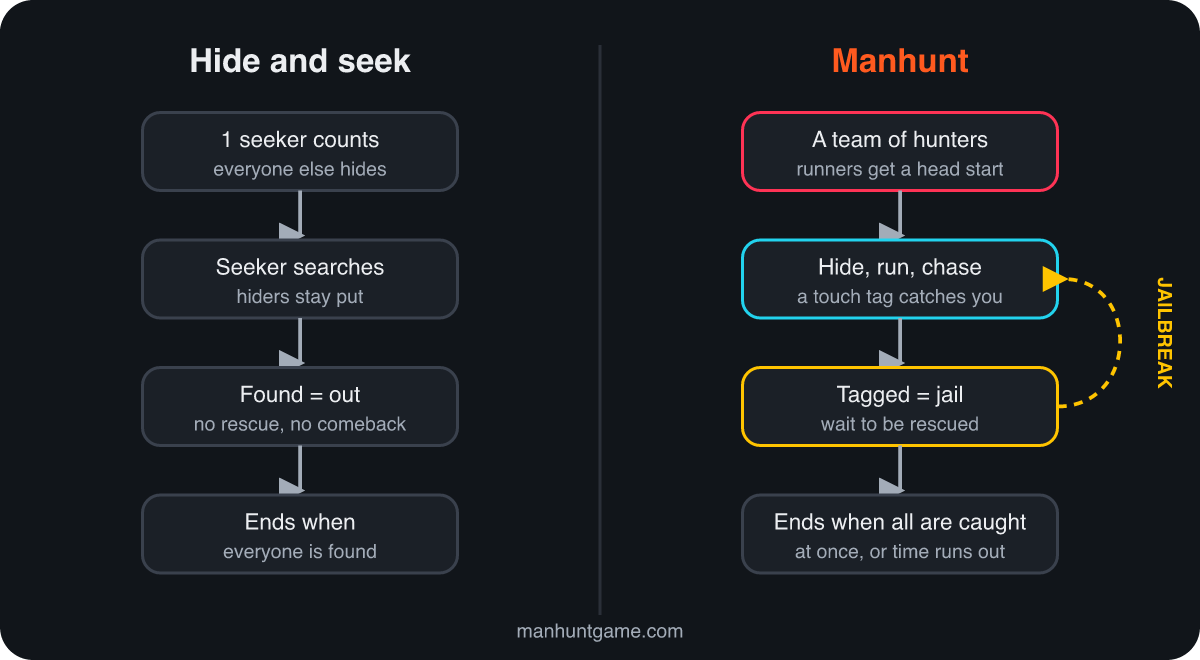
Why Manhunt plays so differently
The jailbreak creates comebacks. In hide and seek, the game only moves one way: more people found. In Manhunt, a single brave runner can reach jail and free everyone, so the hunters are never safe until the last runner is caught. That tension is the whole point, and it’s why hunters end up choosing between guarding jail and hunting.
Runners move. A hider who is spotted in hide and seek is done. A runner who is spotted in Manhunt sprints, doubles back and finds a new spot, so the game is a search and a chase at once.
It’s a team game. Hunters split the area and sweep together; runners distract hunters away from jail and time their rescues. Hide and seek is every person for themselves.
It has an ending. A timer and a clear win condition stop the classic problem of one hider who is never found and a seeker who gives up.
Manhunt compared with other hiding and chasing games
| Game | Who hunts | How you’re caught | When caught | Rescue? |
|---|---|---|---|---|
| Hide and seek | One seeker | Spotted | Out | No |
| Manhunt | A team of hunters | Touch tag | Jail | Yes, jailbreak |
| Tag | One “it” | Touch tag | You become “it” | No |
| Sardines | Everyone but one | Finding the hider | You squeeze in with them | No |
| Kick the can | One “it” guarding a can | Spotted, named and beaten back to the can | Jail | Yes, kick the can |
| Capture the flag | Both teams | Tagged on the enemy’s side | Enemy jail | Yes, by a teammate |
| Ringolevio | Both teams | Held or tagged | Enemy jail | Yes, by a teammate reaching the jail |
| Flashlight tag | One or more with lights | Caught in the beam | Out or jail | Depends on house rules |
Manhunt sits in the middle of this family: the hiding of hide and seek, the chase of tag, and the jail and rescue of kick the can and ringolevio, its closest relatives (see the history of Manhunt).
Which one should you play?
- Under 8, indoors, or a small yard: hide and seek or sardines.
- 6 to 20 players, a park or a quiet block, age 8 and up: Manhunt with jail and jailbreak, using the standard rules.
- A big group where nobody wants to sit in jail: infection Manhunt, where tagged runners become hunters.
- After dark with younger players: flashlight Manhunt, where a beam and a called name replace the tag.
- Camps and clubs with 20 to 30 players: team Manhunt, with two jails, or Jailbreak with a two-jail rule.
How to turn hide and seek into Manhunt
You can switch games mid-evening with three changes:
- Make the seeker a team. One hunter for every three or four players.
- Found isn’t caught. A hunter has to tag a runner with a light touch on the shoulder or back. No tackling.
- Add a jail and a timer. Caught runners wait at a landmark in the middle; a free runner who reaches it untagged frees them. Play for 15 to 20 minutes.
That’s Manhunt. Before the first round, agree on the boundary and a word that stops the game for safety. The how-to-play guide has a one-minute script to read out.
More differences, answered
Is Manhunt the same as tag?
No. Tag is chasing in the open with one "it", and whoever is touched becomes it. Manhunt adds hiding, teams, a head start and a jail. You can think of Manhunt as hide and seek where finding someone only counts once you've tagged them.
Is Manhunt harder than hide and seek?
It's more physical and needs more space, so it suits roughly age 8 and up in daytime, and teens and adults at night. Younger kids usually do better with hide and seek or sardines in a small area.
Can you play Manhunt with just 3 or 4 people?
Yes, with one hunter and a small area such as a big yard. With fewer than four, jailbreaks rarely happen, so many small groups play "found and tagged means you hunt next" instead. See Manhunt with 2, 3 or 4 people.
Why do some people call hide and seek "Manhunt"?
Because the names travel with the game, not with a rulebook. In some towns "Manhunt" means hide and seek played at night over a whole neighborhood; in others it means the jail-and-jailbreak game on this page. Both are real traditions.