Jailbreak: the jail-tag game rules
Jailbreak (also called jail tag, cops and robbers, or simply Manhunt) is a team chase game: hunters tag runners and send them to jail, and any free runner who reaches jail without being tagged frees the prisoners. Hunters win by having every runner in jail at the same time. Runners win if at least one of them is still free when time runs out.
Key facts
- Players: 6 to 30. About a quarter of the group hunts.
- Jail: one clearly marked spot, roughly in the middle. Prisoners stay inside it.
- The rescue: a free runner touches jail (or a prisoner's outstretched hand) and shouts "Jailbreak!". Everyone inside goes free.
- Safety window: freed runners can't be tagged for a count of 20, so hunters can't re-tag them on the spot.
- Guarding: allowed, but only in the open. A hidden guard makes rescues impossible and the game boring.
On this page
Jail is what turns hide and seek into a real game. Without it, being caught just means sitting out. With it, every prisoner is waiting for a hero, every hunter is torn between guarding and searching, and a round can flip in the last ten seconds. These are the jail rules in full; the rest of the game (boundaries, head start, tags) is on the Manhunt rules page.
Setup
- Split the teams. About a quarter of the players are hunters (also called cops or “it”); the rest are runners (robbers).
- Mark jail. One landmark near the middle: a tree, a bench, a lamp post, or cones in a gym. Agree how big it is: “touching the tree” for small games, or a circle about 20 big steps across outdoors.
- Set the boundary and the round length. 15 to 30 minutes outdoors, 5 to 10 in a gym.
- Head start. Hunters wait at jail while runners scatter, 2 to 4 minutes outdoors.
The rules
- Tag. A light two-finger touch on the shoulder or back. No grabbing or tackling.
- Go to jail. A tagged runner says “got me” and walks straight to jail. On the way they can’t be tagged again and can’t rescue anyone.
- Stay in jail. Prisoners stay inside jail. Many groups let prisoners hold hands in a chain reaching out from jail, so a rescuer only has to reach the end of the chain.
- Break out. A free runner who touches jail, or a prisoner’s hand, without being tagged shouts “Jailbreak!”. Every prisoner is free.
- Scatter safely. Freed runners (and the rescuer) can’t be tagged for a count of 20.
- Win. Hunters win the moment every runner is in jail or walking there at once. Runners win if anyone is free at the final whistle.
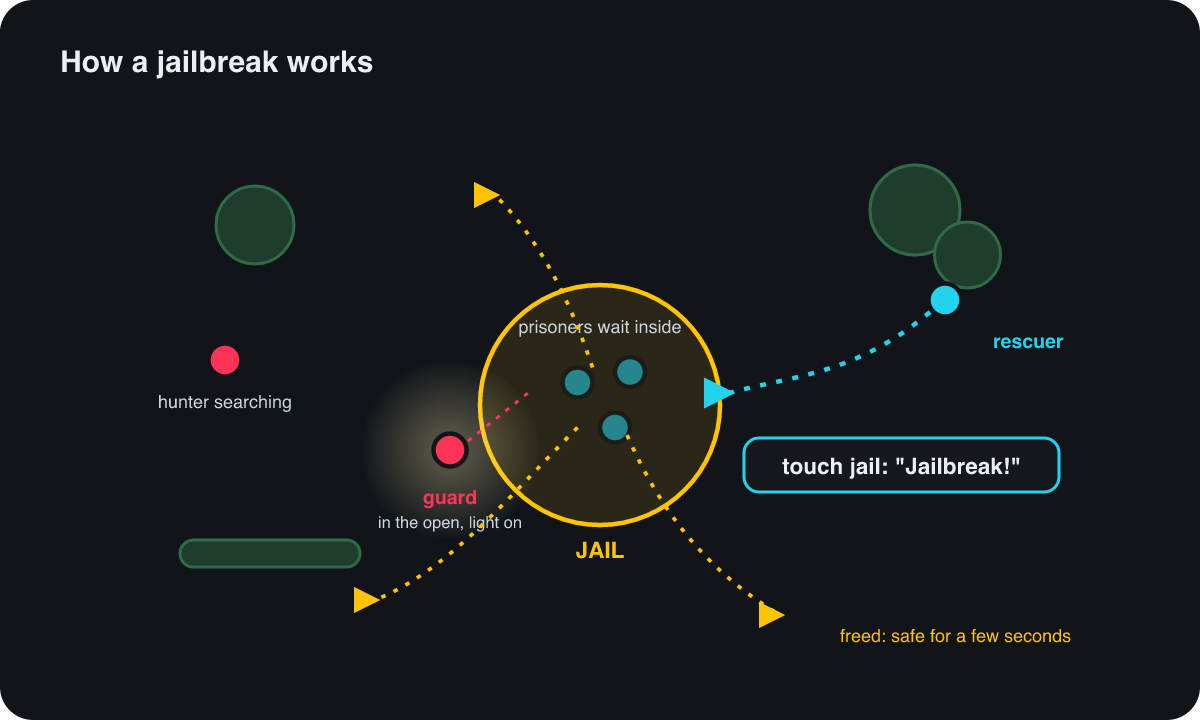
Guarding jail: the fair rule
Guarding is where most Jailbreak games go wrong. If a hunter can hide next to jail all game, nobody is ever freed and the runners stop trying. If guarding is banned, hunters can’t protect a lead. The fix most groups settle on:
- Guards stand in the open, visible from a distance (at night, with a light on).
- One guard at a time.
- No standing on top of jail. A guard stays at least a few big steps away, so a fast runner has a chance.
Ways to run the rescue
| Rule | How it works | Best for |
|---|---|---|
| Free all | One touch frees everyone in jail | Small groups, dramatic comebacks |
| One for one | Each rescuer frees one prisoner | Big groups where free-all swings too hard |
| Chain | Prisoners hold hands in a chain; touching the last one frees all | Fast games, lots of chaos |
| Locked jail | After a break, jail is locked for a couple of minutes | Stopping instant re-breaks |
Versions of Jailbreak
- Cops and robbers. Named teams, the same rules, and roles swap each round.
- Two-jail Jailbreak (ringolevio style). Two teams, each with its own jail; both sides hunt and both sides rescue. Great for 20 to 30 players at camp.
- Gym Jailbreak. Cones for jail, half-court for small classes, a high-five to rescue, and short 5-minute rounds.
- Capture the flag hybrid. Add a flag next to each jail. Carry the enemy flag home to win, or hold the most prisoners at the whistle.
For groups that would rather nobody sits in jail at all, try build-up Manhunt, where tagged runners join the hunters instead.
Arguments, settled
| Argument | Fair answer |
|---|---|
| “I touched jail before you tagged me!” | If both happened at once, the runner wins. Ties go to the rescue. |
| “You were already in jail when I tagged you.” | Anyone inside jail can’t be tagged. |
| “The guard was hiding.” | Then the break counts, and the guard moves into the open. |
| “They got re-tagged the second they left.” | Freed runners are safe for a count of 20. |
| “Nobody said jail was locked.” | It isn’t unless you agreed it before the round. |
Jailbreak questions
How many people do you need to play Jailbreak?
At least six, so there are enough runners for rescues to happen, and up to about 30. Below six, play one-for-one rescues or switch to build-up Manhunt.
Is Jailbreak the same as cops and robbers?
They're the same family. Cops and robbers usually gives the teams names and sometimes swaps roles each round, but the core is identical: tag, jail, rescue.
What do you shout in a jailbreak?
"Jailbreak!" is the most common call. In the old New York game of ringolevio, rescuers shouted "All in! All in! Free-all!", and in New England relievio the call was the name of the game. Agree the word before you start so prisoners know they're free.
How do you play Jailbreak in a gym?
Mark jail with cones in one corner, use half the gym for small groups, and make the rescue a high-five with a prisoner rather than touching the jail line. Two jails at opposite ends, one per team, turn it into a PE-friendly team game.