What is Manhunt?
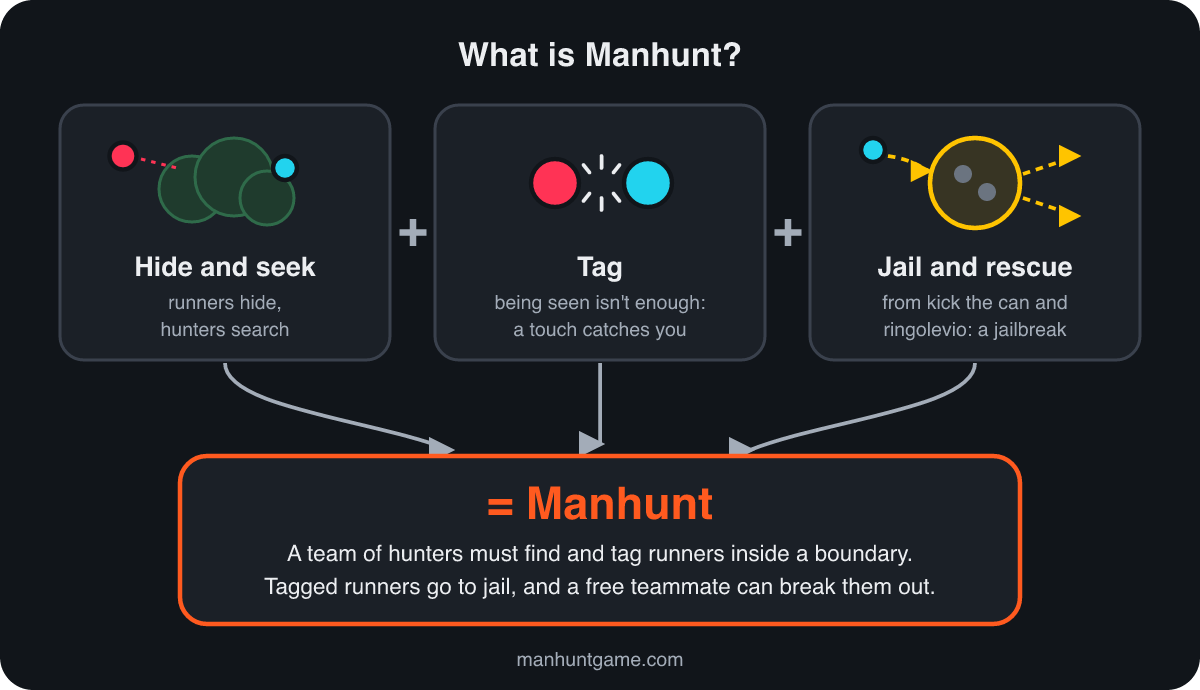
Manhunt is an outdoor chase game in which a team of hunters tries to find and tag runners inside agreed boundaries, often after dark; tagged runners go to jail, and a free teammate can break them out. Think hide-and-seek, except being found isn't enough: you have to be caught, and your team can rescue you.
Key facts
- In one sentence: Manhunt is hide-and-seek plus tag plus a jail.
- Players: 4 or more, best with 6 to 20. About one hunter for every three or four players.
- A round: runners get a 2 to 4 minute head start, then hunters have 15 to 30 minutes.
- Winning: hunters win if every runner is in jail at the same moment; runners win if anyone is free when time runs out.
- Also called: Jailbreak, Jail, Hunt or Manhunt tag. Close relatives: ringolevio, relievo, kick the can, cops and robbers.
- Not to be confused with: Rockstar's 2003 video game, Minecraft Manhunt (a YouTube format), or the TV series and films of the same name. Which Manhunt is which.
On this page
If someone says “let’s play Manhunt,” this is the game they mean: one group hunts, the other hides and runs, and the whole thing turns on the moment a runner sprints into jail and shouts “Jailbreak!” This page explains it from scratch, then points you to the full rules, a first-game guide and, if you want one, the free app.
What does “manhunt” mean?
In everyday English, a manhunt is an organized search for a person, usually someone wanted by the police. The word is old: the Oxford English Dictionary’s earliest evidence is from Thomas Carlyle in 1833. Dictionaries such as Merriam-Webster give that meaning first, and Wiktionary lists the playground game as a second sense.
The game borrowed the word because it describes the game exactly: a team sweeping an area for people who don’t want to be found. On this site, Manhunt with a capital M means the game.
How Manhunt works
| Rule | How it works |
|---|---|
| Teams | A few hunters (about one for every three or four players) and everyone else as runners |
| Place | A park, a quiet block, a campus or a big yard, with a boundary everyone can name |
| Jail | A landmark near the middle, like a tree, a bench or a lamppost |
| Head start | Hunters wait at jail with their eyes closed for 2 to 4 minutes while runners hide |
| The hunt | Hunters search; runners hide, move, and run when they’re spotted |
| The tag | A light touch on the shoulder or back. Seeing someone doesn’t count |
| Caught | A tagged runner walks straight to jail and waits |
| Jailbreak | A free runner who reaches jail untagged frees everyone inside |
| Winning | Hunters win if every runner is in jail at once; runners win if anyone is free when time runs out |
| Length | 15 to 30 minutes a round, then swap roles |
Before the first round, agree on three things: exactly where the boundary is, what counts as a tag, and one stop word that ends the game instantly for everyone. The how-to-play guide has a one-minute script to read out, and the printable rules fit on a single page.
Two games share the name
Ask around and you’ll hear two descriptions of Manhunt, and both are right.
- Jailbreak Manhunt (the standard game): a few hunters, many runners, a jail and jailbreaks, as in the table above. This is what most teens and camps play, and it’s what the rules page covers.
- Build-up Manhunt (“hide and seek in reverse”): one or two people start as hunters, and every runner they catch joins them, until one survivor is left. In some towns the opposite is also played: one person hides and everyone else hunts. See build-up Manhunt.
The rules page explains how to pick between them. If your group can’t agree, play jailbreak rounds with 8 or more players and build-up rounds with fewer.
What is Manhunt tag?
“Manhunt tag” is simply a name for Manhunt that stresses the tag: a runner is only caught when a hunter touches them. Where people use the name, it usually means one of two house rules:
- The build-up version: one person starts as the hunter, and every runner they tag joins the hunt, until one runner is left.
- The hold: a tag only counts if the hunter keeps both hands on the runner and chants “Manhunt, manhunt, 1-2-3!” before they break free. It’s a playground cousin of ringolevio’s “Ringolevio, 1-2-3” hold (glossary).
Either way it’s the same family of games. For younger players or mixed ages, keep the tag a light two-finger touch and skip the hold; grabbing is how people get hurt.
Other names for Manhunt
The same game is also called Jailbreak, Jail or just Hunt. Its close relatives go by ringolevio (New York City), relievo or relievio, kick the can, and cops and robbers or police and thief. Each name, where it’s used and its source are on what Manhunt is called in different places.
How Manhunt differs from hide and seek, tag and capture the flag
- Hide and seek ends for you when you’re found. In Manhunt you’re only out when you’re tagged, you can run for it, and your team can free you from jail.
- Tag is chasing in the open, and whoever is touched becomes “it”. Manhunt starts with hiding, and teams stay the same all round.
- Capture the flag is two teams raiding each other’s side for a flag. Manhunt has no flag: one team hunts, the other survives, and the only raid is the jailbreak.
The full comparison adds sardines, kick the can and ringolevio in one table, and says which game suits which group.
Which Manhunt did you mean?
Who plays Manhunt, and where?
- Friends and neighbors on summer evenings, in parks, backyards and on quiet blocks. Only two or three of you? See small-group Manhunt.
- Families at reunions and holidays, with handicaps that let a 6-year-old and a grandparent play the same game: family Manhunt.
- Birthday parties and sleepovers, usually in a backyard with a parent on the street side: Manhunt for parties.
- Youth groups, camps, scouts and campuses, from 10 to 200 players: Manhunt for groups.
- At night, which is when it’s most fun and needs the most care: Manhunt at night and the Halloween plan.
- Indoors in churches, schools and big houses, with the lights on: indoor Manhunt.
It’s played on foot, inside a boundary that never includes a road. If your group has been talking about “car Manhunt,” read Manhunt with cars and bikes first. Parents and leaders will find the details on Manhunt safety.
Where to go next
- Playing tonight? The quick-start guide gets a first-time host from zero to the first round.
- Settling an argument? The rules answer what counts as a tag, whether hunters can guard jail, and who wins.
- Want a sheet to hand out? The printable rules fit on one page.
- Want to win? Strategy and the best hiding spots.
- Want a referee in your pocket? The Manhunt IRL app, or join a game in your browser.
- Everything else about Manhunt, from variations to guides for groups, starts on the home page.
Sources
- Oxford English Dictionary, manhunt, n.: earliest evidence 1833 (Thomas Carlyle).
- Merriam-Webster: manhunt; Wiktionary: manhunt (the playground-game sense).
- Wikipedia: Manhunt (urban game), Manhunt (disambiguation), Manhunt (video game), Minecraft Manhunt, Manhunt (miniseries), Ringolevio.
- Regional names and their sources: what Manhunt is called. Origins: history of Manhunt.
Questions people ask about Manhunt
Is Manhunt a real game?
Yes. It's a folk game that children, teens and adults have played for generations across the United States and Canada, with no inventor and no official rulebook. The standard rules on this site are the version most groups recognize.
Why is the game called Manhunt?
It borrows the ordinary English word for an organized search for a person: a team searching an area for people who don't want to be found. Nobody has documented when children first used the name for the game; see the history of Manhunt.
Is Manhunt the same as tag?
No. Tag is chasing in the open, and whoever is touched becomes "it". Manhunt starts with hiding, uses teams and a head start, and sends caught runners to a jail they can be rescued from.
What age is Manhunt for?
Daytime games in a small, supervised area work from about age 8. Night games suit teens and adults, or younger players with adults on the boundary. See Manhunt safety.
Do you need an app to play Manhunt?
No. Manhunt needs nothing but a boundary, a jail and a timer. An app such as Manhunt IRL helps with big areas and big groups: it times the round, gives hunters occasional fuzzy location pings, confirms tags and runs the jailbreak.