Running Manhunt with a youth group
To run Manhunt with a youth group, give leaders three jobs (a referee at jail, boundary marshals, and a first-aid and headcount lead), use a smaller area than students would choose, play short rounds with touch tags only, and count heads after every round. Infection and team Manhunt keep 20 to 40 students moving so nobody waits in jail for long.
Key facts
- Group size: 10 to 40 students. Above 30, run two games in separate areas.
- Leaders: a referee at jail, two boundary marshals with lights, and a first-aid and headcount lead. Follow your organization's own supervision ratios.
- Rounds: 10 to 15 minutes each, three or four in an hour, with a headcount between them.
- Best versions: Infection for big groups, team Manhunt with two jails for competitive groups, Flashlight for mixed ages.
- Before the night: permission for the place, a note to parents, and a walk of the boundary in daylight.
On this page
Manhunt is the game students ask for by name at youth nights, lock-ins and retreats. It’s also the one that makes leaders nervous: a large group, the dark, and a lot of running. What follows turns the classic Manhunt rules into a plan a leader can run tonight with 10 to 40 students.
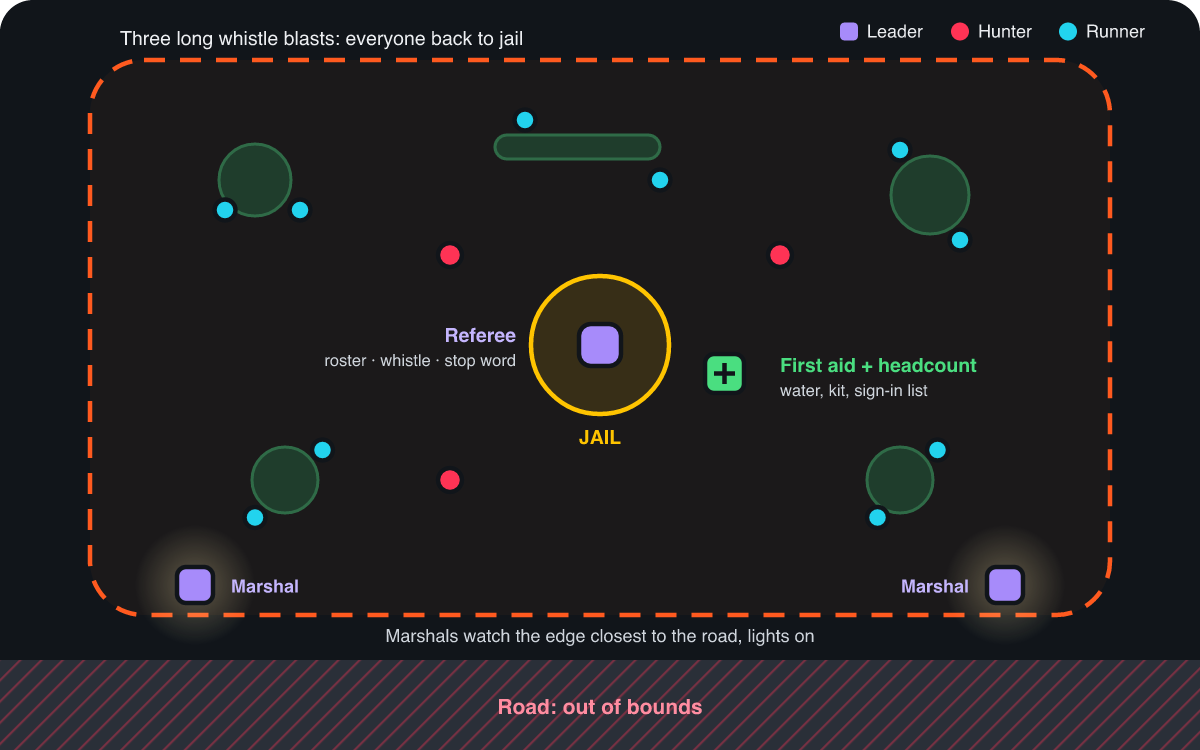
Leader roles
| Role | Where | Job |
|---|---|---|
| Referee | At jail | Starts and ends rounds, settles tag disputes, owns the whistle and the stop word, watches the jail |
| Boundary marshals (2 or more) | On the edges, especially near roads and buildings | Lights on, turn back anyone heading out of bounds, report injuries |
| First aid and headcount lead | Next to jail | Holds the sign-in list, counts heads after every round, has water and a first-aid kit |
| Students who’d rather not run | With the referee | Timekeeper, jail warden, or announcer |
Follow your organization’s own supervision ratios and policies. Our safety guide has starting points by age.
Picking the place
- Somewhere you have permission to be after dark: your church or school grounds, a camp, or a park that’s open in the evening.
- Take out the risky parts: parking lots, the road edge, water, steps, and the inside of any building unless you’re playing the indoor version.
- Walk the boundary in daylight, then again with the students before round one.
- Tell the neighbors if you’re playing near houses. A heads-up can head off a call to the police.
Which version to play
| Group | Version | Why |
|---|---|---|
| 20 to 40 students, mixed | Infection (build-up) Manhunt | Nobody sits in jail; the group ends together |
| Competitive high schoolers | Team Manhunt with two jails, or Jailbreak | Rescues and strategy |
| Mixed ages, younger students | Flashlight Manhunt | Catches happen at a distance, less sprinting in the dark |
| First night with a new group | Classic Manhunt, 10-minute rounds | Learn the area and the rules |
The leader script
Read this before the first round. It takes about a minute.
“Here’s the boundary: [the fence, the path, the edge of the lawn]. The parking lot, the street and the inside of the building are out. Jail is [the lit doorway]. Leaders are standing on the edges with lights; if one of them says stop, you stop. A tag is a light touch on the shoulder or back. No grabbing, no tackling, no pulling clothes. If you’re tagged, walk to jail. If you’re free and you touch jail without being tagged, shout ‘Jailbreak!’ and everyone inside is free. If anyone shouts ‘Freeze’, everybody stops where they are. Three long whistle blasts means everyone comes back to jail. Hunters, eyes closed. Runners, you have two minutes. Go!”
A note for parents
Paste this into your newsletter or event sign-up and adjust the details. It isn’t legal advice; follow your organization’s own permission-form process.
“At [event] on [date], students will play Manhunt, a group hide-and-seek and tag game, on [place] from [time] to [time]. Leaders will supervise at the base and on the boundary, the playing area excludes roads, parking lots and water, and tags are light touches only. Please send your student in shoes they can run in and clothes suitable for the weather, with a small flashlight if they have one. Pick-up is at [place] at [time]. Questions: [leader contact].”
Common problems, solved
- Someone always hides out of bounds. A marshal walks them back, and the second time they help the referee for a round.
- Hunters camp at jail. Allow one guard, standing in the open with a light on.
- The same students always win. Mix teams every round and make the first caught the next hunters.
- Phones. Phones stay in pockets unless your group is using an app to run the game. A phone left behind as a decoy is cheating.
- Bad weather. Move indoors with the lights on and some rooms off-limits (see indoor Manhunt), or play sardines.
Youth group Manhunt questions
Is Manhunt a good youth group game?
One of the best: it needs no equipment, works for 10 to 40 students, gets everyone moving, and mixes quiet students with loud ones naturally. The keys are a clear boundary, touch tags only, short rounds and a leader at jail.
How do you play Manhunt at church?
Use the church grounds with the building and parking lot out of bounds, jail by a lit doorway, and leaders on the edges near the road. In bad weather, a lights-on indoor version works in a large building with some rooms marked off-limits.
What age is Manhunt appropriate for?
Daytime Manhunt in a small supervised area works from about age 8. Night games suit middle and high schoolers with leaders on the boundary. Keep the youngest in pairs, and play Flashlight Manhunt when ages are mixed.
What if a student gets scared or upset?
Anyone can say the stop word or walk back to jail at any time, no questions asked. A student who would rather not run can help the referee keep time and count heads.