What Manhunt is called in different places
Manhunt is also called Jailbreak, Jail or simply Hunt. Its close relatives go by Ringolevio (New York City), Relievo or Relievio (Britain, Ireland, Canada and New England), Kick the Can, and Cops and Robbers or Police and Thief. The details differ, but the core is the same: hunters catch players, hold them in a jail, and a free teammate can set them loose.
Key facts
- Same game, different name: Manhunt, Jailbreak, Jail, Hunt.
- Close relatives: Ringolevio, Relievo and Relievio, Kick the Can, Cops and Robbers, Police and Thief.
- The oldest ancestor: prisoner's base, called "bars" in 14th-century England.
- Nobody owns the name. It's a folk game passed on by kids, which is why every neighborhood's version is a little different.
On this page
Ask ten people who grew up in ten different towns what they called it, and you’ll get a surprising number of answers. That’s what happens to a game nobody owns: it travels by word of mouth, and every street gives it a local name and a local rule or two. This page collects the names we could find in reliable sources, with where each one is used. The story of how the game developed is on the history of Manhunt page.
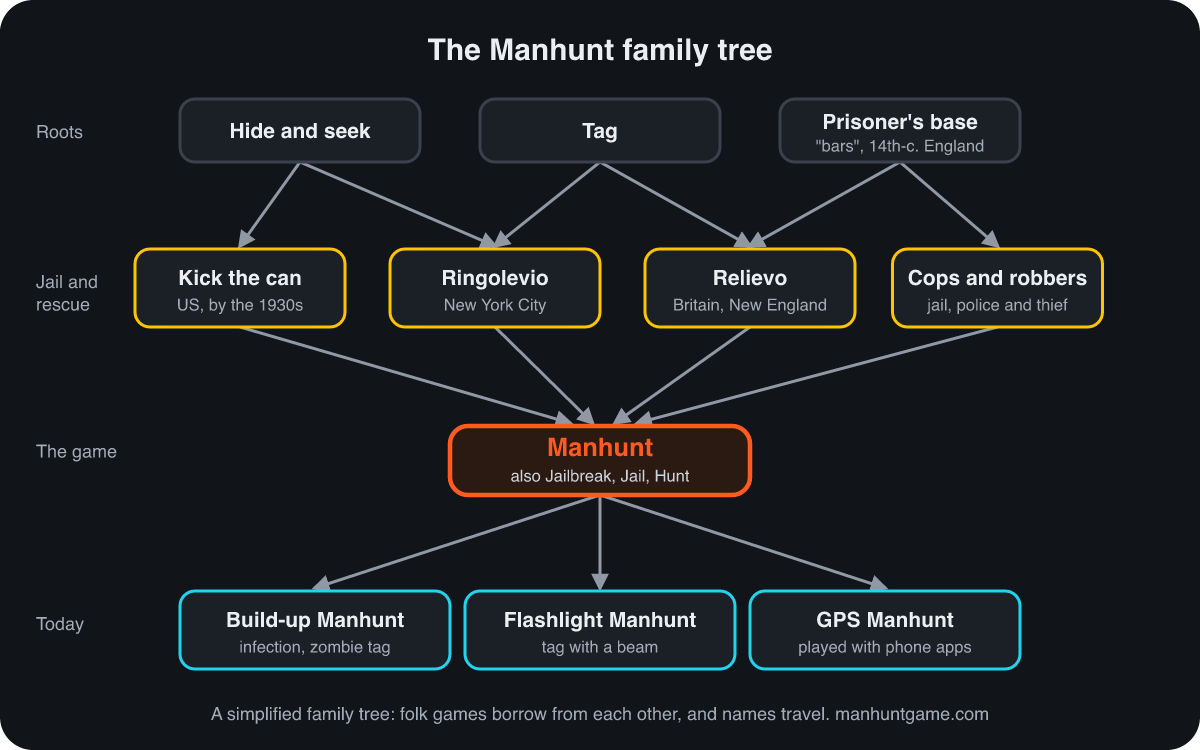
The names, and where they’re used
| Name | Where you’ll hear it | What’s different | Source |
|---|---|---|---|
| Manhunt | The US and Canada | The standard game: hunters, runners, a jail and jailbreaks, often after dark | Wikipedia |
| Hunt | A common short form | Same game | Wikipedia |
| Jailbreak, Jail | Many English-speaking places | The name puts the jail and the rescue first | Wikipedia: Tag |
| Cops and robbers, Police and thief, Jail tag, Team tag, Chase | Across the English-speaking world | Named teams; often played in a smaller space, and roles swap each round | Wikipedia: Tag |
| Ringolevio | New York City, especially Brooklyn, documented since the late 1800s | Two teams, each with its own jail; a captor holds a player through “Ringolevio, 1-2-3”, and rescuers shout “All in!” | Wikipedia |
| Relievio | Canada, Boston and Ireland; a New England street-game tradition | A free player touches the jail and shouts “Relievio!” to free everyone | Wikipedia, USC Digital Folklore Archives |
| Relievo, Releaseo | Britain | Recorded in Iona and Peter Opie’s survey of children’s street games | Opie and Opie, Children’s Games in Street and Playground (1969) |
| Kick the can (also kick the block, 40-40) | The US, popular by the 1930s | One seeker guards a can; kicking it frees everyone in jail | Wikipedia |
| Prisoner’s base, Bars | England, back to the 14th century | Two bases; captured players are held and can be rescued | Wikipedia: Darebase |
A few names we couldn’t pin down
Some names are real in playgrounds but hard to find in any reliable source, so we list them without a region:
- “Manhunt 1-2-3”, for the version where a tag only counts if the hunter holds the runner and chants “Manhunt, manhunt, 1-2-3!”. It echoes ringolevio’s documented “Ringolevio, 1-2-3” hold. See build-up Manhunt.
- Flashlight tag, the night version where a beam replaces the touch. See Flashlight Manhunt.
- Reverse hide and seek, for build-up Manhunt played with only one or two hiders.
Is it all the same game?
Mostly. Every name on this page describes a chase game with catching, holding and rescuing. The differences are in the details:
- One jail or two? Manhunt and Jailbreak usually have one; Ringolevio and prisoner’s base have one per team.
- How you’re caught: a touch, a two-handed hold, being spotted and named (kick the can), or a flashlight beam.
- How you’re freed: touching jail, tagging a prisoner’s hand, or kicking the can.
If your group grew up with different names, you probably grew up with slightly different rules too. Settle them before the first round with the house rules checklist.
What did you call it?
We’re collecting the names people actually used, and where. Email hello@manhuntgame.com with the name, the town or region, and roughly when you played. We’ll add names that come up more than once, credit the region, and date every update.
Name questions
Is Manhunt the same as Ringolevio?
They're close cousins. Ringolevio, the New York City street game, has two teams that each keep a jail and both sides hunt. Manhunt usually has one team hunting and one jail. Both have the same heart: capture, jail and a rescue.
Why is it called Manhunt?
It borrows the word for a search for a fugitive. The full story is in where the name comes from.
What is Manhunt called in the UK?
British players have their own names for jail-and-rescue chase games, such as Relievo, recorded by Iona and Peter Opie in their 1969 survey of children's street games.