How to run a campus Manhunt night
To run a campus Manhunt night, get the event approved by your campus (student activities or campus recreation, with a heads-up to campus police), split big crowds into zones of 20 to 40 players, each with its own jail and marshals, run teams by dorm or floor, and end every round with a headcount by zone. Two hours covers check-in, three or four rounds and a finale.
Key facts
- Size: 30 to 200 players. Split into zones of 20 to 40, each a separate game.
- Permission: book it like any event, and let campus police know the date, time and area.
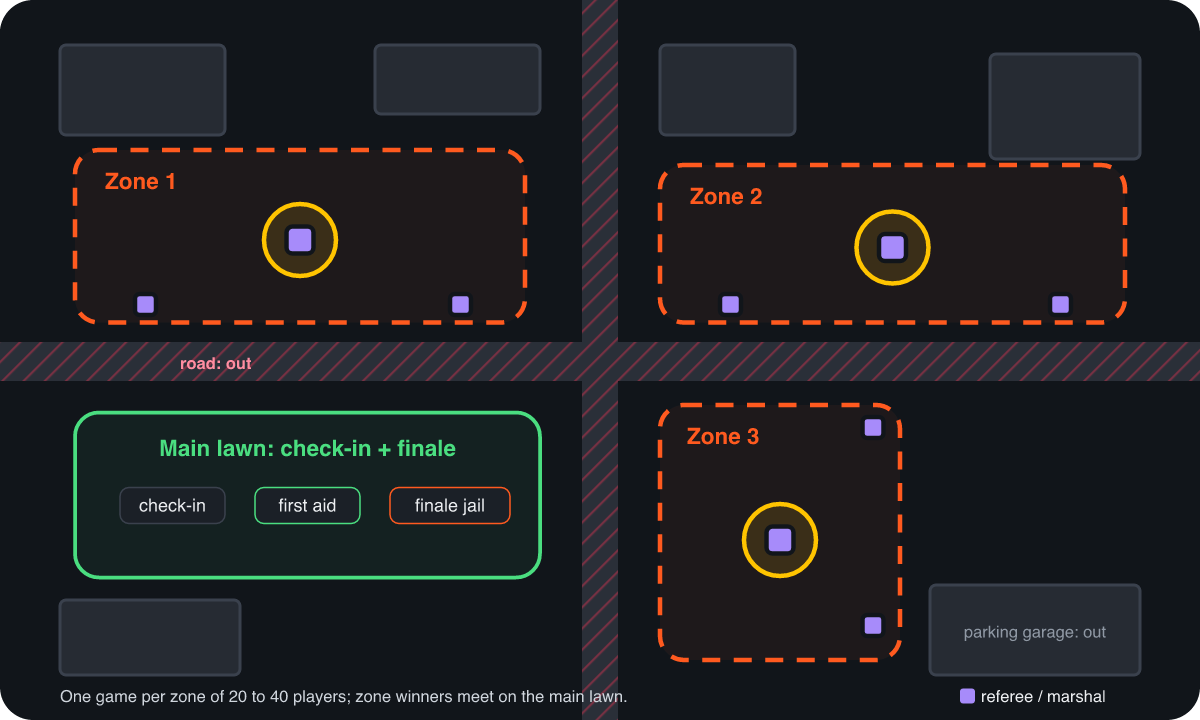
- Staff: per zone, one referee at jail and two marshals on the edges; plus a first-aid point and a check-in table.
- Teams: by dorm, floor or club. Rivalries fill events.
- Time: about 2 hours: 30 minutes of check-in and briefing, 3 or 4 rounds, and a finale.
On this page
A campus Manhunt night is one of the easiest big events a student organization can run: no equipment, no cost, and a game every student already half-knows. It’s also a crowd of people running around campus in the dark, so the organizing matters. The game itself is plain Manhunt; everything below is the organizing.
Six weeks out: permission
- Book it as an event through student activities or campus recreation, and ask which outdoor areas you can use after dark.
- Tell campus police the date, time, area and your contact number. A crowd running between buildings at night looks alarming if nobody told them.
- Check your organization’s insurance and event rules. Many campuses require a registered student organization to host.
- Pick a rain date.
Zones, jails and teams
- One game per zone of 20 to 40 players. Give each zone its own boundary, jail, referee and marshals. Zones should be separate lawns or quads, not overlapping.
- Teams by dorm, floor or club make people show up and bring friends.
- Out of bounds everywhere: building interiors, parking structures, roads, loading docks and construction areas.
- Finale: the last survivors from every zone play one final round together on the main lawn.
Staffing
| Role | How many | Job |
|---|---|---|
| Check-in table | 2 | Sign-in list by zone, wristbands, photo opt-out |
| Referee | 1 per zone | At jail: starts and ends rounds, settles disputes, runs the headcount |
| Marshals | 2 per zone | On the edges nearest roads and buildings, with lights |
| First aid | 1 point for the event | Kit, water, and the organizer’s phone number |
| Organizer | 1 | Keeps time across zones and talks to campus police if they come by |
Run of show (2 hours)
| Time | What happens |
|---|---|
| 0:00 to 0:30 | Check-in by zone, wristbands, rules briefing on the main lawn |
| 0:30 to 1:15 | Three 12-minute rounds per zone, headcount between rounds |
| 1:15 to 1:30 | Break; zone winners announced |
| 1:30 to 1:50 | Finale on the main lawn |
| 1:50 to 2:00 | Final headcount, photos, clean-up |
Photos and video
Tell players at check-in that the event is photographed, give them an easy opt-out (a colored wristband works), and don’t post faces without permission. Blur building names and room numbers in anything you post.
What organizers ask
Do you need permission to play Manhunt on campus?
For an organized event, yes: book it through student activities or campus recreation like any event, and give campus police the date, time and area. Buildings, parking structures and roads should be out of bounds.
How many people can play one game of Manhunt?
A single game works best with up to about 40 players. Beyond that, split the crowd into zones with separate jails and marshals, and bring the winners together for a final round.
What should a campus Manhunt night's photo policy be?
Tell players at check-in that the event is being photographed, give them a way to opt out (such as a colored wristband), and don't post photos that show someone's face without their OK.