Manhunt with cars and bikes
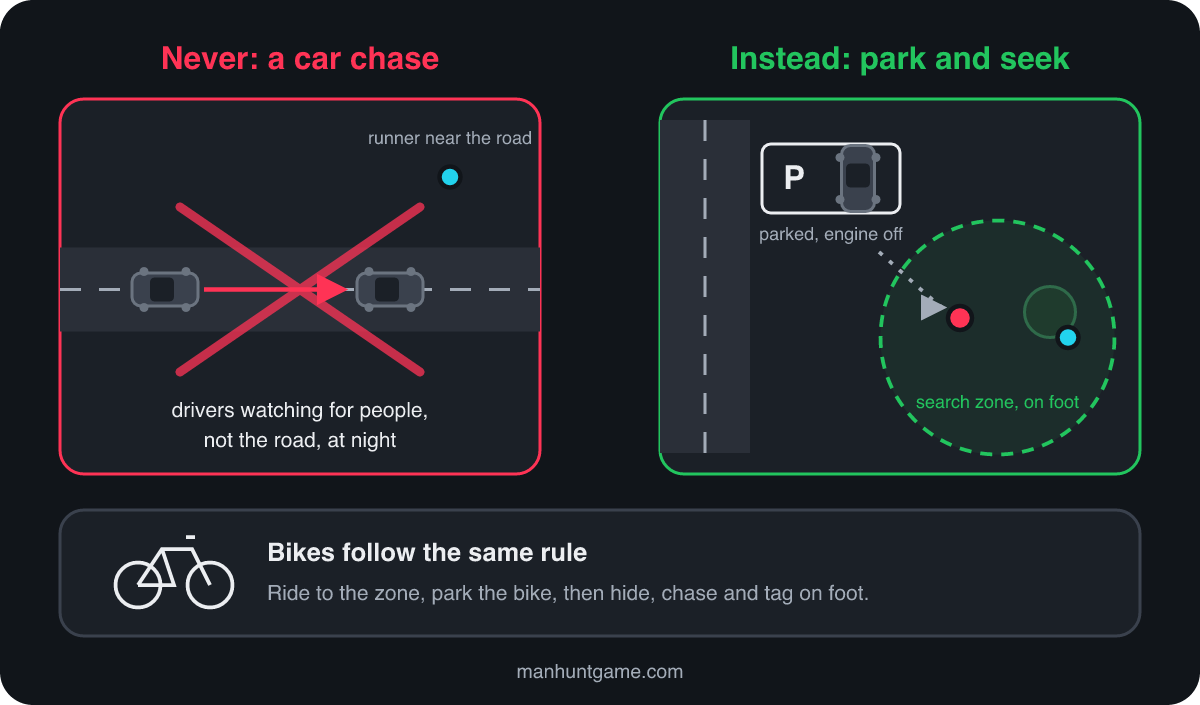
Don't play Manhunt with cars chasing each other or chasing people. A driver who is looking for hidden players isn't watching the road, the game happens at night, and runners hide in the dark near the road. If your group wants a bigger game, play park-and-seek: cars and bikes are only transport, and every search, chase and tag happens on foot.
Key facts
- The one rule: a vehicle never moves while anyone near it is hiding, searching or running.
- Drivers don't search and don't touch a phone. A passenger navigates; the driver drives, parks and turns the engine off.
- Runners never hide in, under, behind or between vehicles, in parking lanes or anywhere a driver can't see them.
- Bikes: ride to the zone, park the bike, then play on foot. Helmets, and lights after dark.
- New drivers: most US states ban all phone use by new drivers, and night driving is when teen drivers are most at risk.
On this page
Once a group of friends can drive, someone always suggests it: “Let’s play Manhunt, but with cars.” It sounds like the natural next level, a bigger map and more speed. It’s also the one version of Manhunt that puts players and drivers on the same roads in the dark. Here’s what goes wrong, and a version that keeps the fun without the chase on wheels.
Why car chases and Manhunt don’t mix
- The driver’s eyes are in the wrong place. Manhunt is a search. A driver who is scanning hedges and parking lots for a hidden friend is not scanning the road for everyone else.
- Runners hide exactly where drivers can’t see them: behind parked cars, in dark driveways, crouched by a curb. In an ordinary game that’s good hiding. With cars moving, it’s the worst place to be.
- It happens at night, with a full car. The CDC reports that teen drivers’ fatal crash rate at night is about three times that of adult drivers per mile, and that each extra teen passenger raises an unsupervised teen driver’s crash risk (CDC: risk factors for teen drivers).
- Phones come out. Car Manhunt runs on texts and maps. 49 states and DC ban texting while driving, and most states ban any phone use by new drivers (GHSA: distracted driving laws).
- A chase looks like a chase. Cars circling a neighborhood at night, people running between houses: neighbors call the police, and “it’s a game” doesn’t help once somebody has run a stop sign. The Manhunt at night guide covers how even foot games get groups in trouble.
Park-and-seek: the car version that keeps every chase on foot
The simplest answer: drive to one park, everyone parks at jail, and play standard Manhunt there. That’s still the best version. If your group really wants a whole town as the map, park-and-seek keeps the bigger map and removes the chase.
- Pick three to five zones before anyone gets in a car: public places that are open at that hour and have legal parking, such as a park with open hours, a school field you’re allowed on, or a town green. Each zone has a clear walking boundary that doesn’t include a road.
- Small cars, sensible drivers. One car hides, the others hunt. Each car carries a driver and one or two passengers at most, and every driver follows their state’s rules for new drivers, passengers and night hours. An adult driver is better still.
- The clock starts when the hiders are parked. The hiding car drives to one zone at the speed limit, parks legally and turns the engine off, and only then texts “on foot.” The head start (10 minutes) starts with that text, so nobody has a reason to rush.
- Hunters drive to a zone, park, and search on foot. Nobody searches from a moving car. Nobody gets out until the car is parked with the engine off.
- Tags happen on foot, with the usual light touch. A runner who is spotted can run within the zone but can never run to a car or into a road.
- Nothing moves while players are out. No car leaves a zone until every player from that car is back in it, seat belts on.
- Clues instead of chases. If hunters strike out, the hiding team texts a clue from where they’re hiding (a sign they can see, a color). Drivers never text; a passenger reads it out.
- A hard end time and a check-in. The game ends at a set time wherever everyone is; every car sends “home” to the group when it arrives.
Bike Manhunt
Bikes feel safer than cars, but the same problem applies: riding fast in the dark while looking for hidden people is how riders hit curbs, walkers, parked cars and each other.
- Bikes are transport. Ride to the playing area together, park the bikes at jail, and play on foot. In a big park, runners can ride to a zone during the head start and leave the bike there.
- No riding during the hunt. A runner or hunter on a moving bike is out for the round. Bikes can’t be used to escape a tag.
- Helmets, and lights after dark. A front light and a rear light on every bike ridden to or from a night game.
- Scooters, e-bikes, skateboards and golf carts follow the same rule. E-bikes are fast enough to count as vehicles.
A bigger game without wheels
- City Manhunt: for adults: a whole neighborhood or city on foot and public transit, where seekers close in by asking questions over hours.
- Campus Manhunt night: several zones and jails for 30 to 200 players, with staff on the edges.
- Build-up Manhunt: in a big park, the growing pack of hunters makes a large area feel small.
Car and bike Manhunt questions
What is car Manhunt?
A version some teens play after getting their licenses: teams drive around town, hiders park somewhere, and hunters drive around to find them, sometimes chasing when they do. The chasing part is the dangerous part. Park-and-seek keeps the driving and the bigger map but moves every chase onto foot.
Is car Manhunt illegal?
Driving around isn't, but the things that tend to happen in a car chase game can be: speeding, reckless driving, phone use by the driver, breaking a new driver's passenger or night limits, and being in a lot or park after it closes. Laws vary by state, so check yours, and treat "we were just playing a game" as no defense.
Can you play Manhunt on bikes?
Use bikes to get between zones, not to chase. Riding fast at night while looking for people hiding in the dark is how riders hit curbs, walkers and each other. Park the bikes at jail or at the zone, then play on foot.
Should I let my teenager play car Manhunt?
Only park-and-seek, with a driver who has held a license long enough to be allowed passengers at night where you live, a phone-free driver, a fixed end time and a text when everyone is home. If the plan is "we chase each other," the answer is no.